
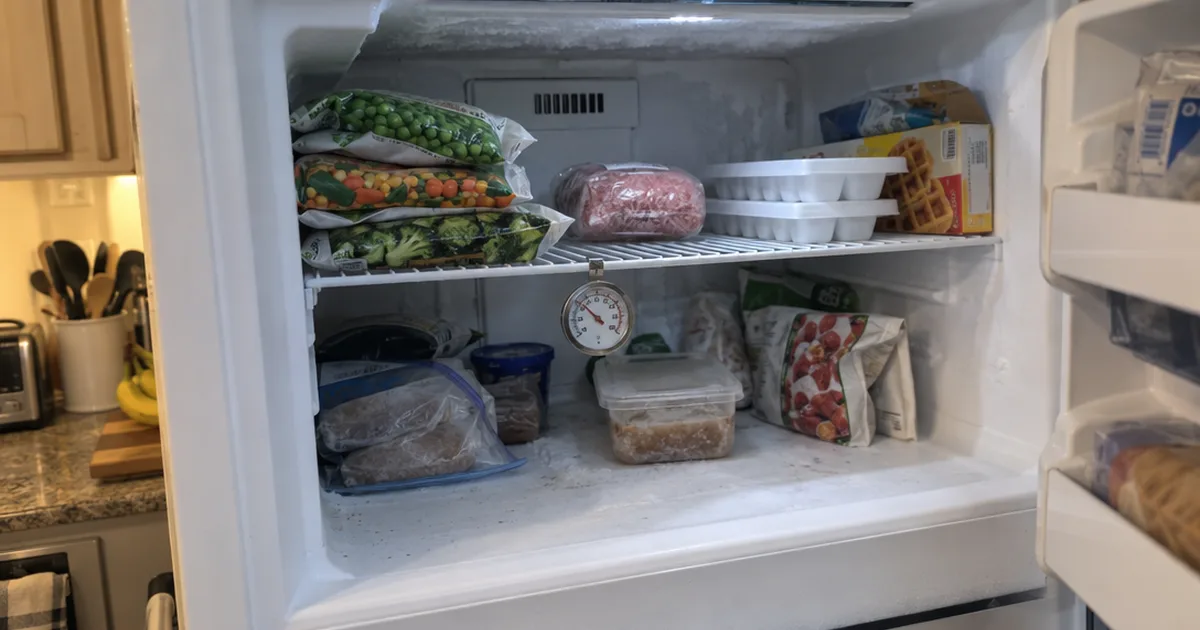
Water turns to ice at 32°F, but your freezer should run 32 degrees colder than that.
The target is 0°F (-18°C), and every food-safety source in this article agrees on it.
So why do so many freezers miss it?
Because the number on the dial isn’t a thermometer, and it’s easy to go years without checking the real freezer temperature inside.
Here’s the exact number in both scales, how to check yours in 20 minutes, what the dial numbers really mean and how to fix a freezer that runs off target.
What Temperature Should a Freezer Be?
A home freezer should be set to 0°F (-18°C) or lower. That’s the setting Bosch tells its freezer owners to use to keep food fresh and safe.
The FDA draws the same line. Real Simple reports the FDA advice in a guide updated August 11, 2026: freezer at or below 0°F, refrigerator at or below 40°F.
Why does 0°F matter so much?
At that temperature, food stays in a solid frozen state. The same guide says that prevents the growth of harmful bacteria and preserves your food’s quality and nutrition.
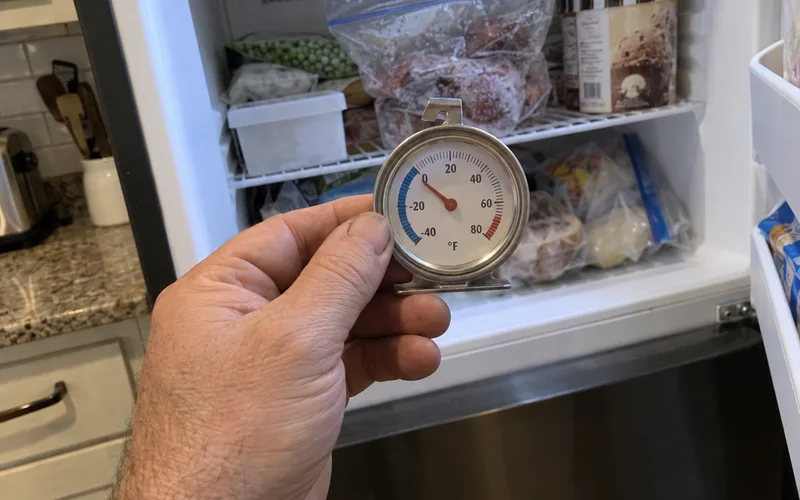
So “0°F or colder” is the whole answer for any home freezer, whether it sits on top of your refrigerator or stands on its own.
It’s also the one setting that keeps one of your hardest-working major kitchen appliances doing its real job: food preservation, not just making ice.
Why 0°F and Not 32°F?
A freezer near 32°F is only barely below the point where water freezes, so it has no room for error. The 0°F target leaves a cushion that keeps frozen foods solid when warm kitchen air rushes in.
And warm air rushes in a lot.
The Bosch guide notes that opening the door often causes temperature swings, especially in a hot kitchen. That cushion is what keeps a quick snack run from softening everything inside.
Freezer Temperature Chart: Fahrenheit and Celsius
The ideal freezer temperature in Fahrenheit is 0°F, which converts to -17.8°C, so manufacturers round it to -18°C. Here’s what nearby readings mean for your frozen foods:
| Thermometer reading | Celsius | What it means |
|---|---|---|
| 10°F | -12°C | Above target: turn it colder |
| 5°F | -15°C | Above target: turn it colder |
| 0°F | -18°C | The target for a home freezer |
| -5°F | -21°C | Safe, a little colder than needed |
| -10°F to -20°F | -23°C to -29°C | Range Bosch gives for frozen treats |
Anything above the 0°F row needs a colder setting.
Anything below it is safe for food, but you pay for that extra cold in energy consumption, as the section on colder freezers explains.
What Is the Ideal Freezer Temperature in Celsius?
The ideal freezer temperature in Celsius is -18°C or lower, the metric match for 0°F. A display that reads -17°C is a hair too warm, since 0°F is actually -17.8°C.
So nudge a -17°C display one step colder.
You’ll see -17°C quoted as the ideal on some websites. It’s close, but -18°C is the number that keeps you at or below the 0°F line.
Refrigerator and Freezer Temperatures Side by Side
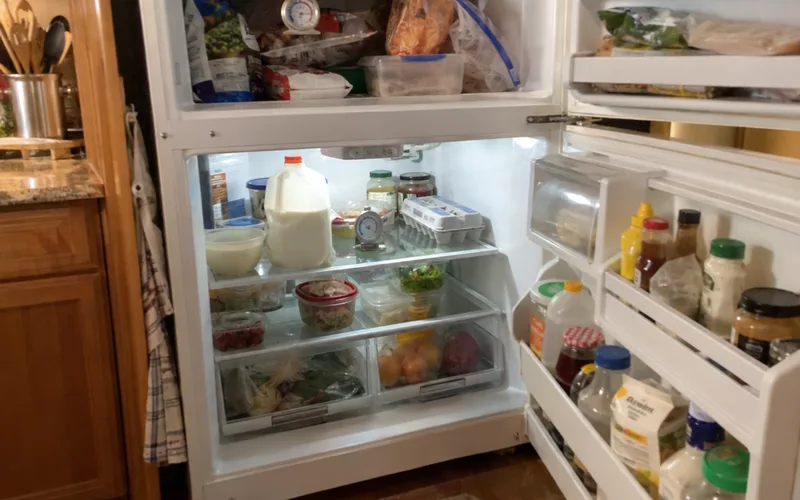
A refrigerator works best at 35°F to 38°F (1.7°C to 3.3°C), while the freezer belongs at 0°F (-18°C) or lower. Real Simple gives that fridge range as the ideal, a few degrees under the FDA limit of 40°F.
So the two compartments sit about 35 degrees apart.
That gap is why you set and check the fridge and the freezer separately. Give each compartment its own thermometer, so one reading never stands in for the other.
Why does the fridge range stop at 35°F?
Go much colder and the fresh food side starts to freeze lettuce, eggs and dairy products. The freezer has the opposite job, so it should never drift up toward fridge territory.
How to Check Your Freezer Temperature
The only reliable way to check a freezer temperature is an appliance thermometer in the center of the freezer, not the dial. Real Simple notes that it’s not uncommon for a refrigerator to run a few degrees off the setting you chose.
A few degrees matters when the target is a single number.
Here’s how to get a true reading:
- Get a freestanding appliance thermometer that reads below 0°F. A cheap dial or digital model from a hardware store works.
- Put it in the center of the freezer, away from the door. The Bosch guide warns that the area near the door may be warmer.
- Close the door and leave it alone. The same magazine says to leave the thermometer in place for 20 minutes, then check the reading.
- Read it quickly and shut the door, so you don’t let the cold air out while you look.
If it reads 0°F or below, you’re done.
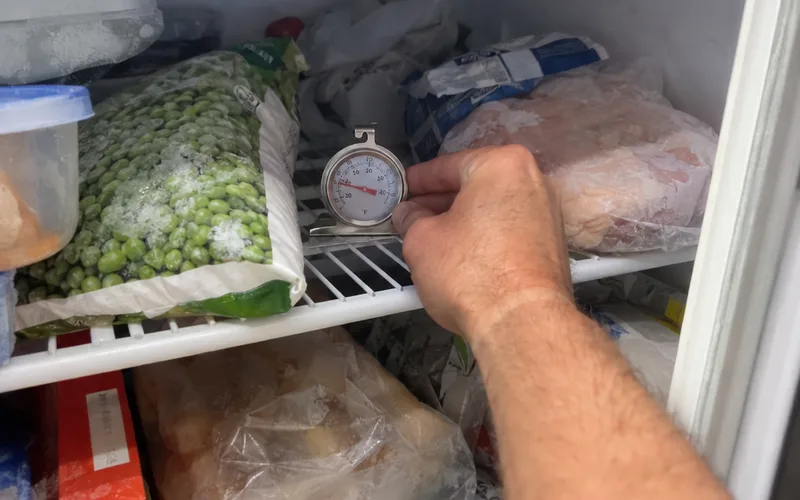
If it doesn’t, write the number down so you can compare it after you adjust the control.
Want a reading without opening the door at all? A digital freezer thermometer with an outside display, often sold as a freezer temperature monitor or gauge, shows the number on the front of the appliance.
Pro Tip: Check again after anything that disturbs the freezer, like a big grocery haul, a long door-open session or a power outage. If the outage tripped your controls, the steps to reset a Frigidaire after an outage show how a typical unit comes back online.
What Do the Numbers on a Freezer Dial Mean?
The numbers on a freezer dial, such as 1 to 7 or 1 to 5, are cooling levels, not degrees, so no single number equals 0°F on every model. Even which end is coldest depends on the model, so check the label or manual first.
That’s why one source says “set it to 4” and another says “5.”
Neither can be right for every freezer.
The right number for your freezer is whichever one holds 0°F on your thermometer. Start near the middle of the scale, check with the thermometer and move one step at a time.
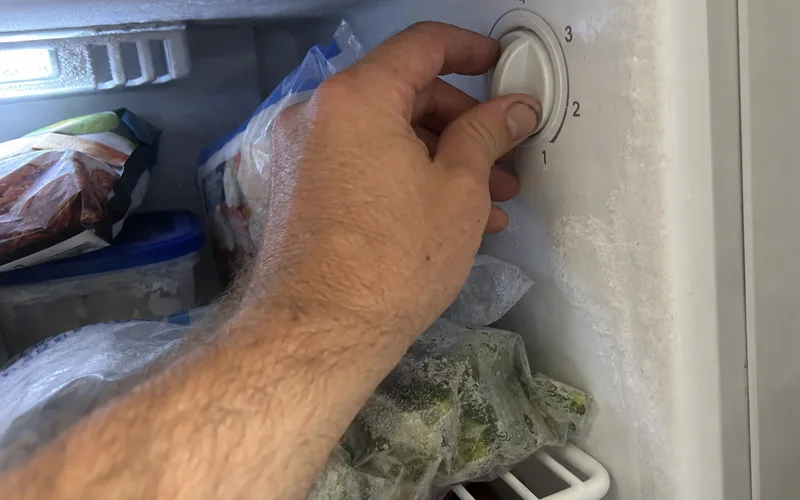
Here’s an example:
Say your dial sits at 3 and the thermometer reads 6°F after a full day. You move it to 4, wait another day, and it reads 1°F.
One more step to 5 brings it to -2°F, so 5 is your number. That’s 3 days of checking, and you never have to guess again.
Brand matters here. A Frigidaire, Beko or Liebherr freezer each labels its temperature control its own way, and the manual’s controls page shows which direction is colder.
Fridge dials work on the same idea. If you’re also trying to decode the refrigerator side, the fridge 1-5 scale has its own quirks.
How to Adjust Your Freezer Temperature
To adjust a freezer temperature, move the dial one step colder or enter a lower number on the thermostat, then recheck your thermometer 24 hours later. The Bosch guide gives that 24-hour wait so the temperature can settle before you judge it.
On a digital panel, the number you enter is a target, not a measurement of what’s inside. So the thermometer still has the final say.
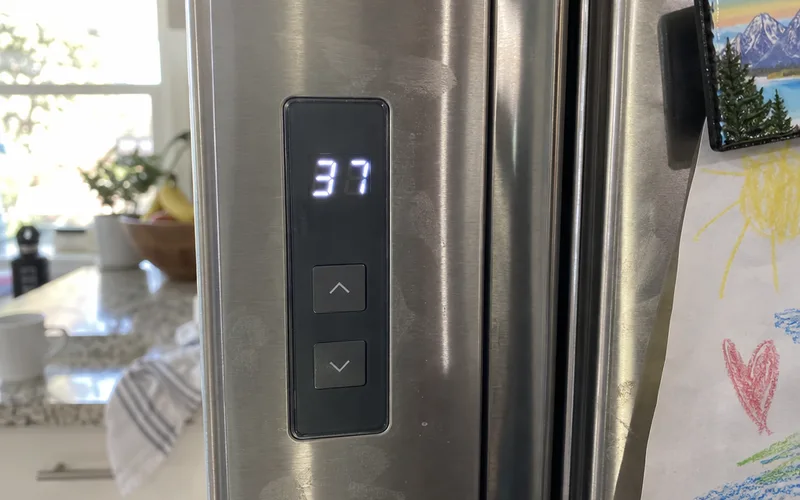
And don’t chase the number.
If you turn the dial two steps, check after an hour and turn it again, you’ll overshoot and never learn which setting actually works.
Here’s a simple routine:
- Change the setting by one step only.
- Leave the door shut as much as you can.
- Read the thermometer in the same spot 24 hours later.
- Repeat until the reading sits at 0°F or a little below.
Key Takeaway: One step, one day, one reading. That’s how you find the setting that holds 0°F in your kitchen.
How Long Does a Freezer Take to Reach 0°F After a Change?
A freezer needs about 24 hours to reach and hold a new setting, which is the wait the Bosch guide gives before you check the temperature again. A freezer packed with unfrozen groceries can take longer, because all that food has to cool too.
That’s also why a reading taken an hour after a change tells you very little.
Give it the full day, then trust the thermometer.
Is a Colder Freezer Better?
A freezer set colder than 0°F, such as -10°F, is safe for food but not better for everyday storage. Real Simple warns that keeping a freezer too cold can run up your utility bill and cause food to lose moisture and flavor.
So is -10°F too cold?
Not for safety, since it sits well under the 0°F line. For your electricity bill and the taste of your food, it’s colder than everyday storage needs.
In other words, 0°F is the best everyday balance of energy consumption and food quality, and colder is a choice you make for a reason.
There are two good reasons, and both come down to texture.
Ice Cream and Other Frozen Treats
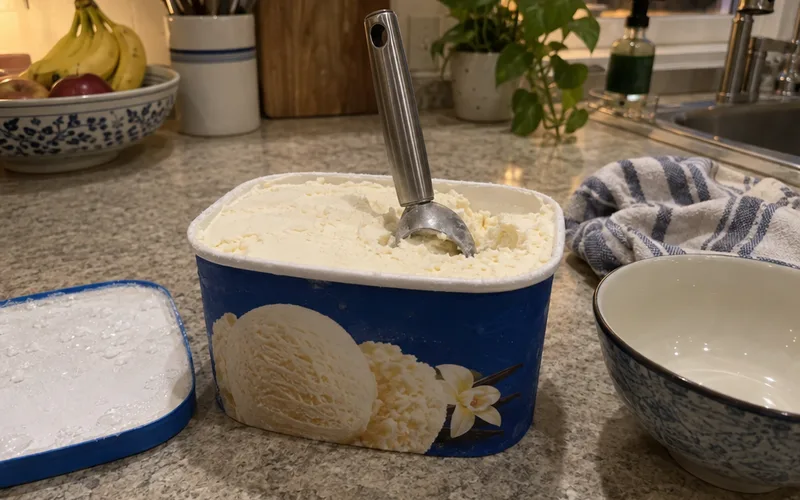
Ice cream and other frozen desserts may do better at -10°F to -20°F (-23°C to -29°C). The Bosch freezer guide gives that range to keep a creamy texture without becoming too hard.
That’s much colder than the -12°C (10°F) some websites suggest for it, which sits above the 0°F line. If you like yours creamy, try one step colder and see how it scoops.
High-fat fish is the other exception. The same guide says fish like salmon keeps its texture and flavor better at the colder end of the recommended range.
Signs Your Freezer Is Too Cold
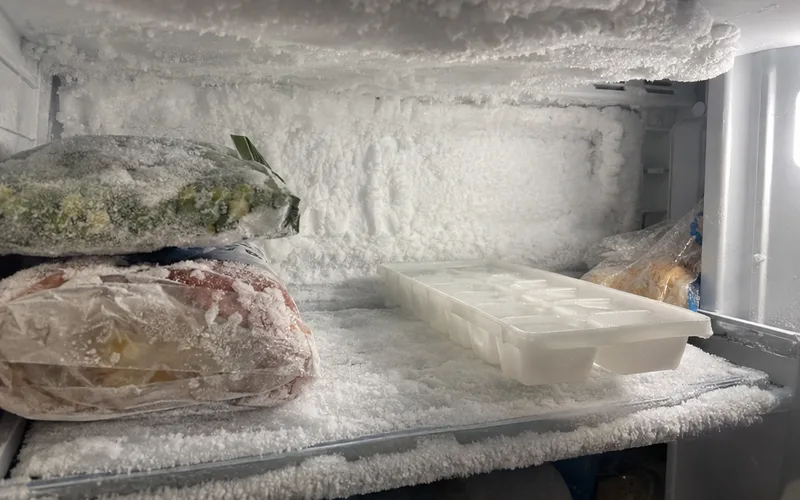
The clearest sign your freezer is too cold is heavy ice buildup inside, which Real Simple calls a sure sign that the temperature is set too low. A thermometer reading well below 0°F confirms it.
Watch for these clues:
- Thick frost or ice on the walls, shelves or vents
- Frozen desserts too hard to scoop straight from the freezer
- Dry patches and ice crystals on meat, vegetables and fruit
- A thermometer that reads far below 0°F day after day
Is my freezer too cold if I only see one of these?
Not always, so let the thermometer decide. If it confirms a very low reading, turn the control one step warmer and recheck the next day.
What to Do If Your Freezer Is Too Warm
If your freezer reads warmer than 0°F, turn the control one step colder, then check the door seal, the airflow, how often the door opens and whether warm food is going in. Each of those has a quick check you can do tonight.
Start with the seal.
The Bosch guide suggests the dollar bill test: close the door on a bill, and if it pulls out easily, the seal may not be tight enough. A worn gasket lets cold air leak out all day, and the freezer can’t keep up.
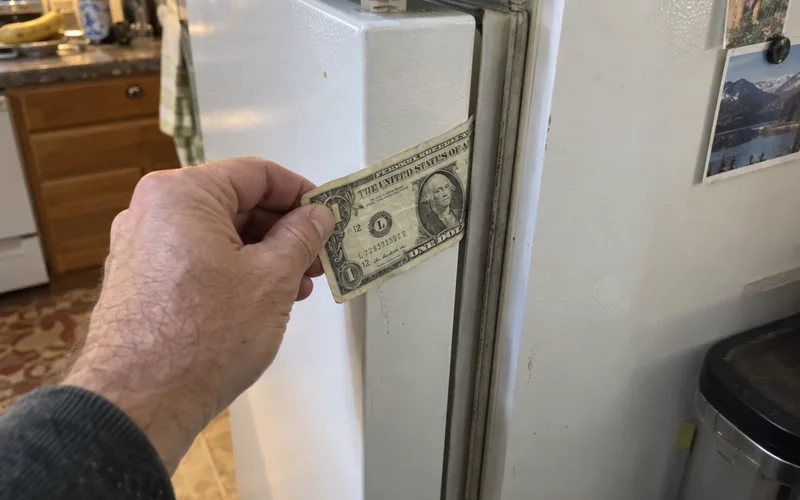
For example, say your thermometer reads 9°F on a Sunday night. You turn the control one step colder, and on Monday it reads 5°F, better but still above target.
The dollar bill slides out of the lower corner of the door with no drag. A new gasket fixes the leak, and by Wednesday the thermometer holds 0°F.
The other usual suspects are just as quick to check:
| Problem | Quick check | Fix |
|---|---|---|
| Leaky door seal | Dollar bill test | Clean or replace the gasket |
| Blocked airflow | Food pushed against vents | Leave room around the vents |
| Frequent door opening | Door open for long stretches | Grab what you need and shut it |
| Warm food going in | Hot leftovers straight in | Let food cool a bit first |
On that last row, Real Simple says to let hot food cool for a bit, but not all the way to room temperature, before you cover and store it.
Still above 0°F a day after these fixes? Then the problem may be inside the sealed cooling system, such as the compressor, a sensor or a refrigerant leak.
That’s work for a technician. Before you call, the refrigerator not cooling checklist helps you rule out the simple causes.
Model quirks matter too. The fixes for a Samsung that won’t cool differ from Whirlpool cooling fixes, and GE refrigerator troubleshooting covers that brand’s own resets.
And if only one side has trouble, a cold freezer with a warm fridge points to a different set of causes than a warm freezer does.
Does a Full Freezer Run More Efficiently?
A full freezer holds its temperature better than an empty one, but Real Simple says to leave around 20 percent of the space open so cold air can still move. Mostly full, never crammed, is the goal.
Why does fullness help?
Frozen food acts as thermal mass, meaning it stores cold and gives it back slowly. When you open the door, the air warms up, but the solid frozen packages barely change, so the freezer recovers faster.
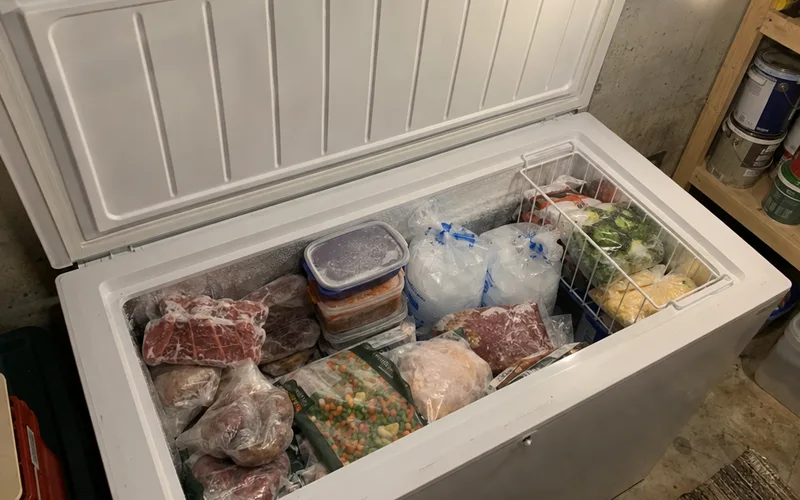
An empty freezer has only air to hold the cold, and that air spills out every time you open the door.
Running low on food? A few bags of ice or containers of water fill the gaps and add thermal mass of their own, as long as they stay clear of the vents.
How much a full freezer cuts energy consumption depends on the model, so treat it as a bonus. The bigger win is a steadier temperature for the food already inside.
Does Freezing Food Kill Bacteria?
Freezing food at 0°F stops harmful bacteria from growing rather than killing them. Real Simple says freezers deter bacterial growth for months, or sometimes even indefinitely.
Deter is the key word.
Both the magazine and the Bosch guide describe freezing as stopping growth, not as wiping bacteria out. So whatever was on raw meat or fresh fruit when it went in can start growing again once the food thaws and warms.
What does that mean for you?
Freezing keeps safe food safe, but it can’t rescue food that was already spoiling. So freeze food while it’s fresh, thaw it in the fridge, and cook thawed meat the way you would fresh meat.
That’s also why a freezer that creeps above 0°F matters for food safety, not just texture.
Freezer Burn and Temperature Swings
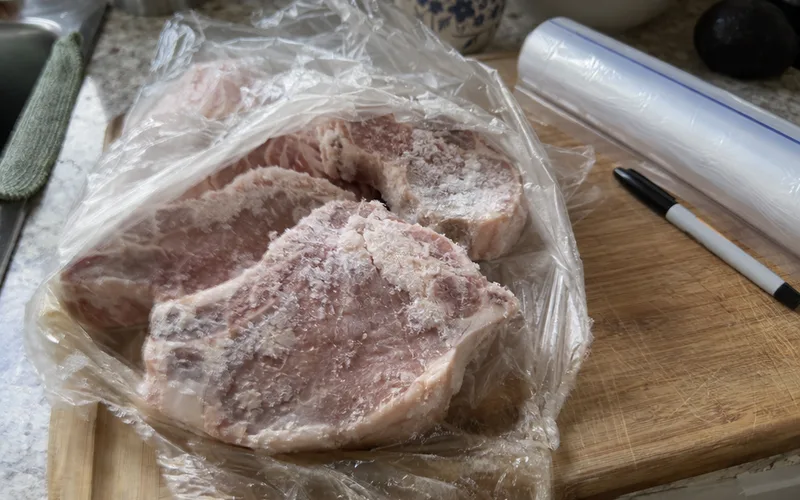
A colder freezer doesn’t cause more freezer burn as long as it holds steady, because freezer burn is moisture loss from frozen food and temperature swings make it worse. Real Simple says some freezers offer a flash-freeze option that drops the temperature for 24 hours to avoid freezer burn when you add a lot of warmer food.
What about a freezer that’s always very cold?
The magazine links a freezer kept too cold to food losing moisture and flavor, and links swings to freezer burn. So a steady 0°F beats both extremes.
No flash-freeze button?
Turn the control one step colder a few hours before a big load goes in, then set it back once the new food is frozen. Wrap food tightly and press out the air, since packaging keeps that moisture where it belongs.
Chest and Deep Freezer Temperature
A chest freezer or deep freezer should be set to the same 0°F (-18°C) or lower as the freezer above your refrigerator. The temperature target doesn’t change with the shape of the appliance.
What does change is where it lives.
If yours sits in a garage or basement, the room matters: the Bosch guide notes that a room that’s too hot or too cold can affect the appliance’s efficiency. So check a garage freezer with a thermometer in both summer and winter, when the room swings hardest.
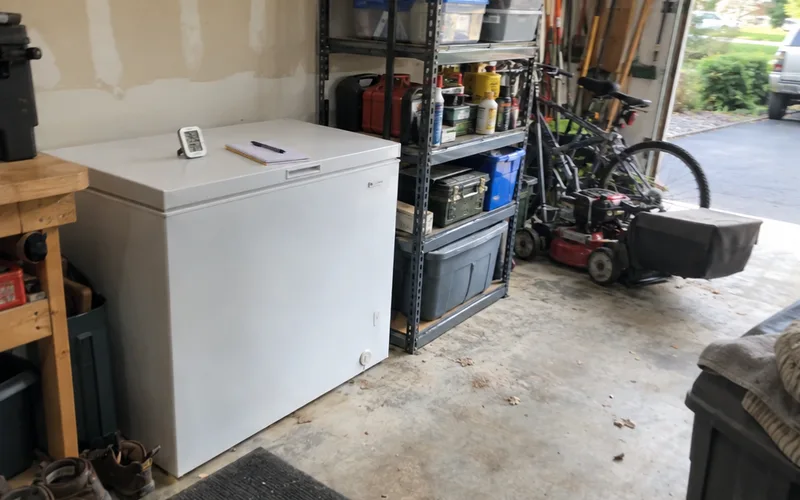
Manual-defrost chest models also build frost over time. If thick ice forms fast, read it as the too-cold sign described above and turn the control one step warmer.
The One Number to Remember
Keep your freezer at 0°F (-18°C) or colder, and trust a thermometer over the dial.
Put an appliance thermometer in the center of your freezer today and read it in 20 minutes.
Frequently Asked Questions
Is 0 degrees cold enough for a freezer?
Yes, 0°F (-18°C) is cold enough for a home freezer, because it’s the limit the FDA recommends, as Real Simple reports. Keep it at 0°F or a little below, and check it with an appliance thermometer rather than the dial.
Why is my freezer temperature different from the setting?
A freezer temperature can differ from the setting because controls aren’t exact, and Real Simple notes it’s not uncommon for a refrigerator to run a few degrees off. Trust an appliance thermometer in the center of the freezer, then adjust the control one step at a time.
Is my freezer too cold?
Your freezer is too cold if a thermometer in the center reads well below 0°F or you see heavy ice buildup, which Real Simple calls a sure sign of a too-cold setting. Turn the control one step warmer and check the thermometer again after 24 hours.
Is 10 degrees cold enough for a freezer?
No, a freezer at 10°F (-12°C) is warmer than the 0°F (-18°C) limit the FDA recommends, as Real Simple reports. Turn the control one step colder at a time until a thermometer in the center reads 0°F or lower.
What is -18°C in Fahrenheit?
Minus 18°C is about 0°F, the standard home freezer temperature, since the exact conversion of 0°F is -17.8°C. A display that shows -17°C is slightly warmer than 0°F, so set it to -18°C or lower.
How do I set the temperature on my Frigidaire, Beko or Liebherr freezer?
A Frigidaire, Beko or Liebherr freezer is set with its own dial or control panel, and the owner’s manual shows which end of the scale is coldest. Aim for 0°F (-18°C), then confirm the result with an appliance thermometer after 24 hours.