
A Japanese chef’s knife can cost $47.96 or $875 at the same store.
Both were gyutos, the Japanese take on a chef’s knife, on the Cutlery and More knife listing in November 2026. One was a 7-inch Kiwami on sale, the other an 8.25-inch Damascus Miki.
So a price tag alone won’t tell you which kitchen knives you actually need.
Below are the 3 knives that handle most home cooking, with the size and cost of each and how to keep them sharp and safe.
This guide is one part of our larger knives section, so head there for anything more specialized.
The 3 Kitchen Knives Most Home Cooks Need
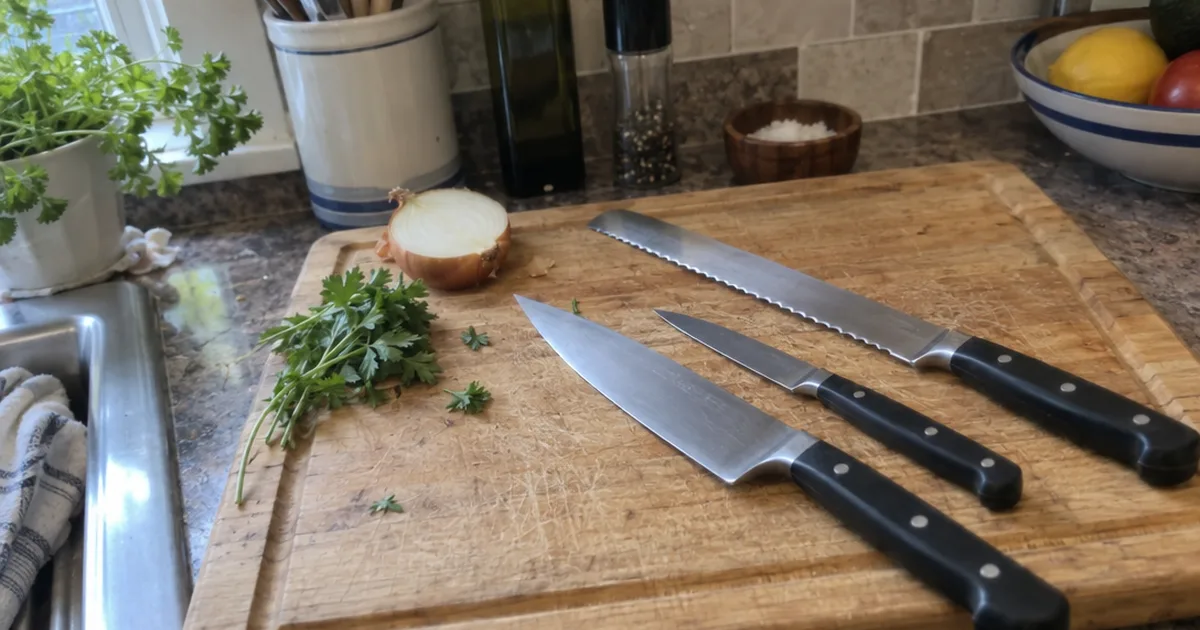
Most home cooks need just 3 kitchen knives: an 8-inch chef’s knife, a 3- to 4-inch paring knife and a serrated bread knife. Every other blade is a specialist you add when a recipe keeps asking for it.
That trio covers the 3 kinds of cutting a home kitchen does most: big chopping, small precise work and sawing through crust.
Here’s the order I’d buy them in:
1. An 8-Inch Chef’s Knife
An 8-inch chef’s knife is the kitchen knife to buy first, because it chops vegetables, slices meat and minces herbs. If you only ever own one knife, make it this one.
- Best for: Everyday chopping, dicing onions, slicing chicken and mincing garlic. Skip it if you have small hands, where a 6-inch chef’s knife or a santoku feels easier.
- Size: 8 inches of blade, measured from heel to tip.
- Steel: Stainless steel, which handles wet and acidic food without rusting.
- First step: Hold a few in a store and pick the handle that lets you chop without your knuckles hitting the board.
For a price anchor, the Wüsthof store listing priced its Classic 8-inch chef’s knife at $170.00 in November 2026. That’s well above the $47.96 gyuto and far below the $875 one, so treat it as a mid-range benchmark.
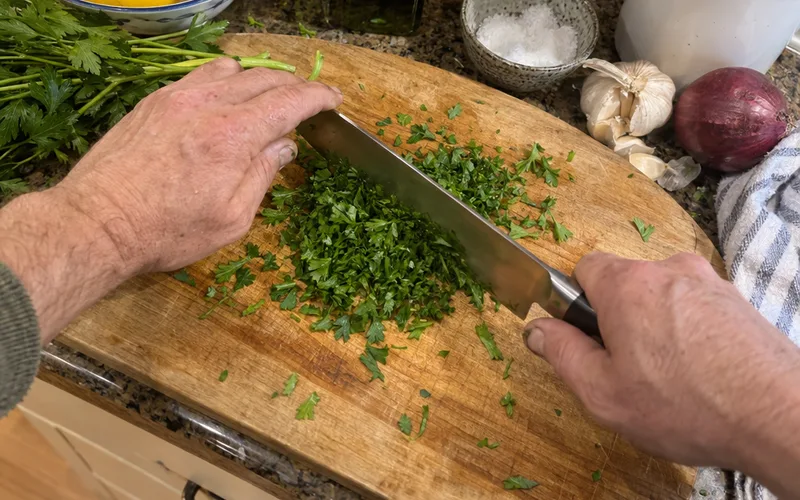
The blade’s curved edge lets it rock from tip to heel, which is why it’s so quick on a pile of herbs. Learning to use a chef’s knife well is mostly about that rocking motion and a curled-finger grip on the food. Once that feels natural, our knife skills guide covers the basic cuts.
For paper-thin, even slices of cucumber or potato, a mandoline is faster than any knife. Meat is a different story, and slicing meat on a mandoline comes with its own rules.
2. A 3- to 4-Inch Paring Knife
A paring knife is a small kitchen knife, about 3 to 4 inches long, for jobs too fiddly for a chef’s knife. Think peeling an apple, hulling strawberries or coring a tomato.
- Best for: Peeling, trimming, coring, deveining shrimp and scoring the skin on fruit. Skip it if you already own a small utility knife you like.
- Size: 3 to 4 inches.
- Steel: Stainless steel, thin and light, because control matters more than weight here.
- First step: Check that the handle is long enough to hold firmly when you peel in midair.
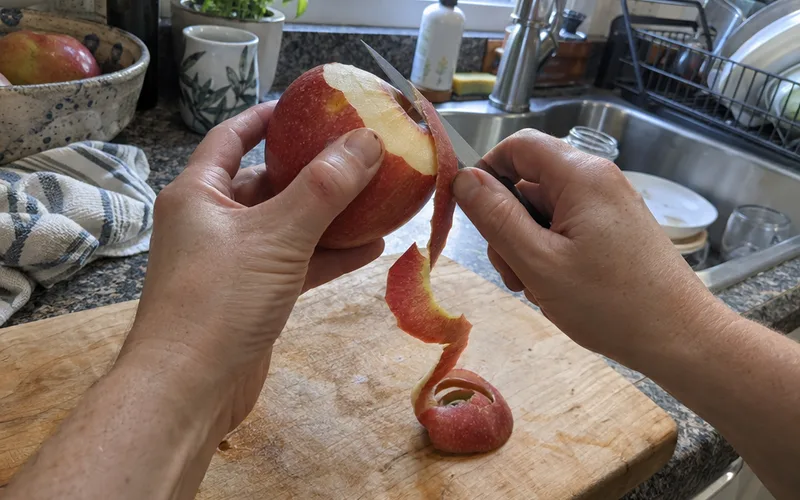
The same Wüsthof listing put its Classic 3 1/2-inch paring knife at $95.00. A paring knife does small jobs, so it’s the easiest of the 3 to buy on a budget.
There are more jobs for a paring knife than most people expect.
3. A Serrated Bread Knife
A serrated bread knife has a scalloped edge that saws through crusty bread without crushing the soft middle. It’s the third knife because neither a chef’s knife nor a paring knife can do that job cleanly.
- Best for: Bread, bagels, cake layers, tomatoes and citrus. Skip it only if you never buy whole loaves or bake.
- Size: Long enough to cross your widest loaf in one stroke.
- Steel: Stainless steel.
- First step: Measure the loaf you buy most, then choose a blade a few inches longer.
In fact, a Target kitchen knife page calls a serrated knife best for breads, cakes and even citrus fruits. Those foods share a tough outside and a softer inside.
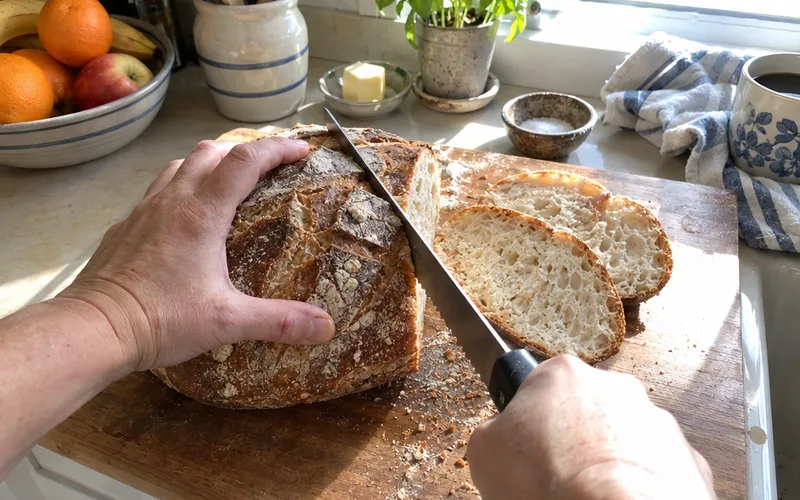
That tough-outside, soft-inside test is the easiest way to spot when a serrated knife wins. Tomatoes fit that pattern, and there’s a quick guide on how to chop tomatoes without squashing them.
Other Kitchen Knife Types and What They Do
Kitchen knife types beyond the core 3 are specialists, from the Japanese santoku to the heavy cleaver, each built to do one job better than a chef’s knife. Add one only when you cook that job often enough to notice the difference.
Here’s what each one is for:
- Santoku: a Japanese all-purpose knife, usually shorter than a chef’s knife, with a straighter edge and often dimples that keep slices from sticking.
- Utility knife: a mid-size blade between a paring knife and a chef’s knife, for sandwiches, cheese and small fruit.
- Boning and fillet knives: narrow blades for cutting meat off bones, the fillet version thinner and more flexible for fish.
- Carving knife: a long, narrow slicer for roasts, turkey and ham.
- Cleaver: a heavy rectangular blade for chopping through bone and hard squash.
- Nakiri: a Japanese vegetable knife with a flat edge for straight up-and-down cuts.
The santoku is the one most people weigh against a chef’s knife. The santoku vs chef’s knife choice mostly comes down to whether you rock the blade or chop straight down.
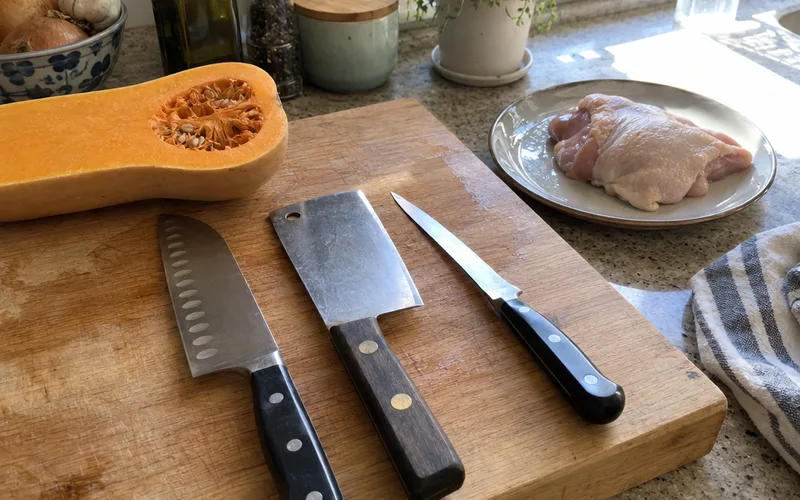
A butcher knife sits at the heavy end of the family, with a wide blade for breaking down big cuts of meat. Some even have a hole near the spine, and the hole in a butcher knife has a practical reason behind it.
Steak knives and butter knives are different again. They’re cutlery for the table, not prep tools, and a butter knife even has a fixed spot in a place setting.
If you want a set for the dinner table, compare steak knives for the table on their own instead of buying them inside a block. For a closer look at every blade, there’s a full rundown of each knife type and its use.
What Size Chef’s Knife Should You Buy?
An 8-inch chef’s knife is the right size for most home cooks. Go down to 6 inches for small hands or a small cutting board, or up to 10 inches for big batches.
Why does 8 inches win? It’s long enough to slice through a head of cabbage in one pass, yet short enough to control on an ordinary cutting board.
Japanese gyuto knives are sized in millimeters instead. A 210 mm gyuto is close to an 8-inch chef’s knife.
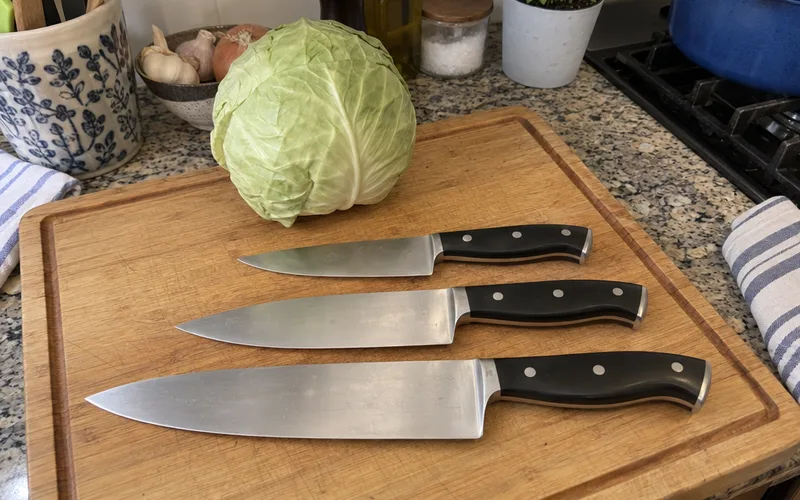
Your cutting board sets a hard limit, too. A long blade on a small board hangs off the edge, so a small board pairs better with a 6- or 7-inch knife.
Grip matters more than the number. So if a 6-inch knife feels steadier in your hand, that’s the right size for you.
Once you know your size, comparing chef’s knives gets much easier, because you can skip every model in the wrong length.
Knife Set or Individual Knives?
Buying individual kitchen knives is the better deal for most home cooks, because block sets pad their piece count with extras. A set only makes sense when you’re starting from zero and it includes a good chef’s knife, paring knife and bread knife.
Here’s an example, with a made-up set for illustration only.
Say a 15-piece block holds 6 steak knives, a pair of shears, a honing steel and the block. That leaves 6 prep knives, and maybe 3 that you’d reach for every week.
Before you buy any set, count the actual prep knives and check that the 3 core ones are in it. If one is missing, you’ll end up buying it on its own anyway. The same check applies to pricey direct-sale sets, which our Cutco knives review weighs up.
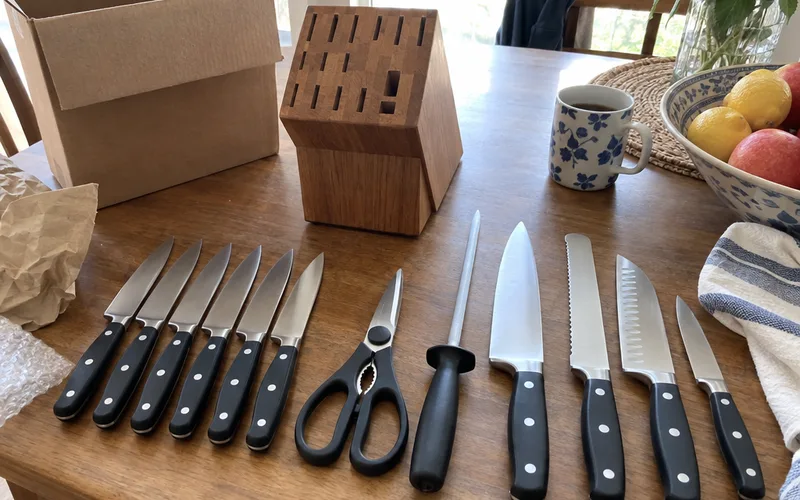
Individual knives also let you mix brands and styles. You could pair a German chef’s knife with a Japanese paring knife, which no matching set will do.
How Much Does a Good Kitchen Knife Cost?
A good chef’s knife cost from under $50 to $170 at store listings checked in November 2026. Cutlery and More had a 7-inch Kiwami gyuto on sale for $47.96, and Wüsthof listed its Classic 8-inch chef’s knife at $170.00.
Hand-forged Damascus knives cost far more, such as an $875 Miki gyuto at the same store. The extra money mostly buys fancier steel, forging and hand finishing, which matter more to a collector than to a weeknight dinner.
Here’s the math on a premium German pair. At the maker’s own November 2026 prices, the Classic chef’s knife and the Classic paring knife came to $265.00 together.
That’s a real sum for 2 knives. So on a tight budget, spend most on the chef’s knife and less on the paring and bread knives, which do smaller jobs.
German vs Japanese Kitchen Knives
German kitchen knives are heavier, tougher and curved for a rocking cut, while Japanese knives are usually thinner, harder and straighter for clean push cuts. Choose German if you want a forgiving workhorse and Japanese if you want a lighter blade you’ll treat gently.
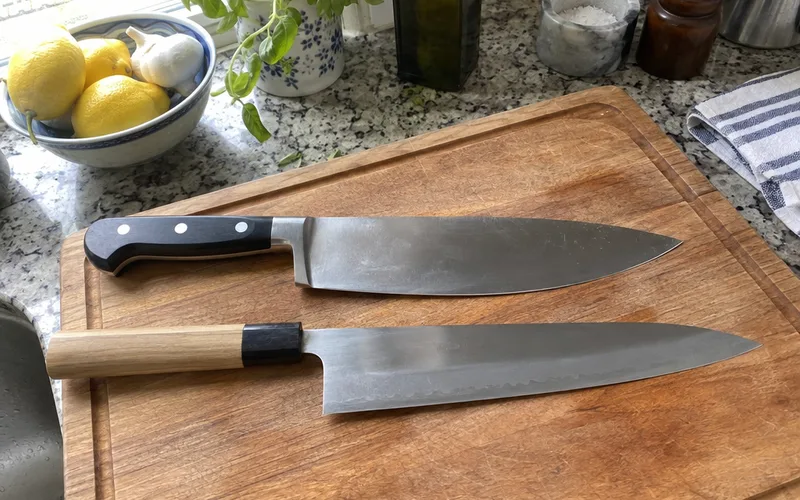
The Wüsthof page says Western European knives, especially from Solingen, are often double beveled, with both sides angled to a point. Their curved belly helps a steady rocking motion when you chop.
That curve is why an 8-inch German chef’s knife rocks so easily over herbs and garlic. On the German side, the top German knife brands share that same heavy, curved style. Our Henckels knives review looks at one of the best-known Solingen names.
Japanese knives trade some of that durability for a finer edge. A hard, thin edge can chip if you twist it in a squash or hit a bone, so it rewards a gentler hand.
The santoku and the gyuto are the Japanese knives most home cooks meet first. The wider family of Japanese knives goes much further than those two.
If you’re torn, the brand matters less than the style. Pick German or Japanese first, then narrow it down with a list of the best kitchen knife brands in that style.
Forged vs Stamped Kitchen Knives
A forged knife is shaped from one hot piece of steel, so it’s heavier and usually has a thick bolster. A stamped knife is cut from a flat sheet, so it’s lighter and cheaper.
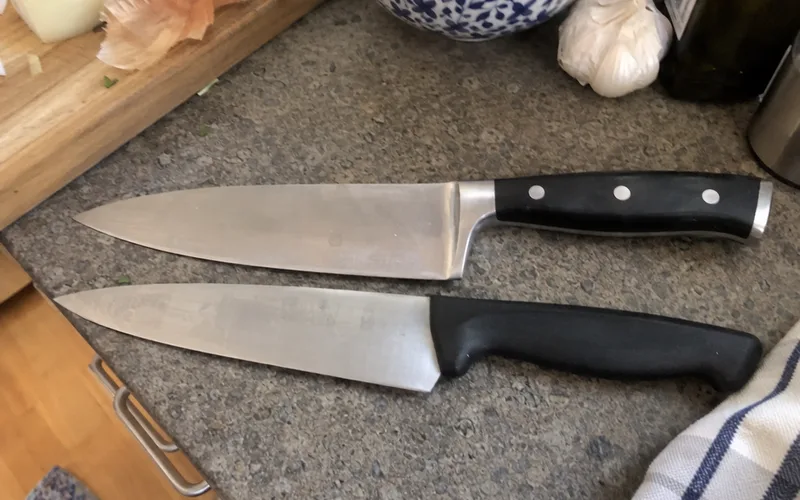
Neither one is automatically sharper, because the steel and its heat treatment matter more than the method. For example, Wüsthof says its forged knives start as one piece of German steel, hardened to 58 on the Rockwell hardness scale.
That scale measures hardness. A higher number means harder steel that holds an edge longer but can chip more easily.
The bolster is the thick collar of steel where the blade meets the handle. It adds weight and keeps your fingers from sliding onto the edge.
Here’s the practical test: hold one of each.
If you like a heavy knife that pushes through carrots under its own weight, go forged. If your wrist tires, go stamped.
Stainless Steel or Carbon Steel Knives?
Stainless steel is the better choice for most kitchen knives, because it resists rust and stains from wet or acidic food. Carbon steel takes a keen edge and sharpens easily, but it rusts and darkens unless you wash and dry it right after use.
Stainless steel gets its rust resistance from chromium mixed into the steel. Carbon steel has little or none, which is why a cut tomato or lemon can leave a gray stain on it.
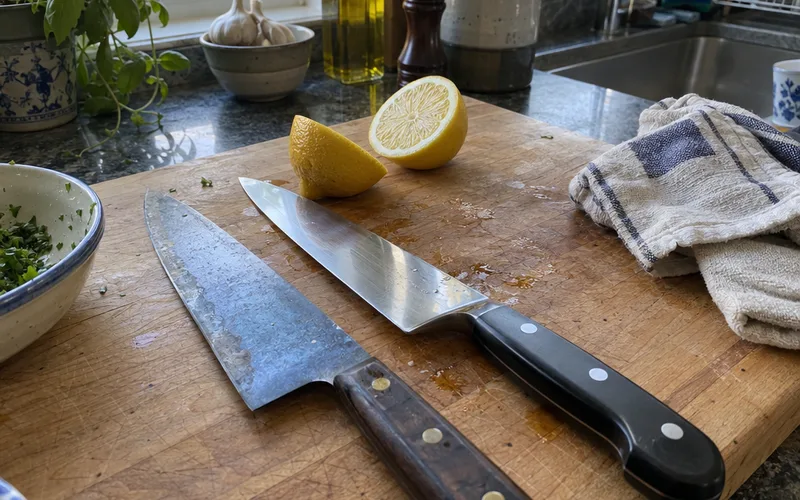
Many knives sold as “high-carbon stainless” try to split the difference. They add carbon for a harder edge while keeping enough chromium to resist rust.
Even a stainless blade spots when it sits wet in a dish rack. So if you see orange flecks on your knives, learn how to stop rust spots on a blade before they pit the steel.
How to Keep Kitchen Knives Sharp
Kitchen knives stay sharp with 2 habits: honing on a steel every few uses, and sharpening on a whetstone or sharpener once honing stops working. A mail-in service is a third option, and its cost is the main reason to learn the job yourself.
A sharp knife is also a safer knife. A dull one needs more pressure, and that’s when a blade skids off an onion toward your hand.
Honing vs Sharpening
Honing and sharpening are different jobs: honing pushes a bent edge back into line, while sharpening grinds steel away to form a new edge. Honing removes almost no steel, so the rod in a knife block can’t fix a truly dull knife.
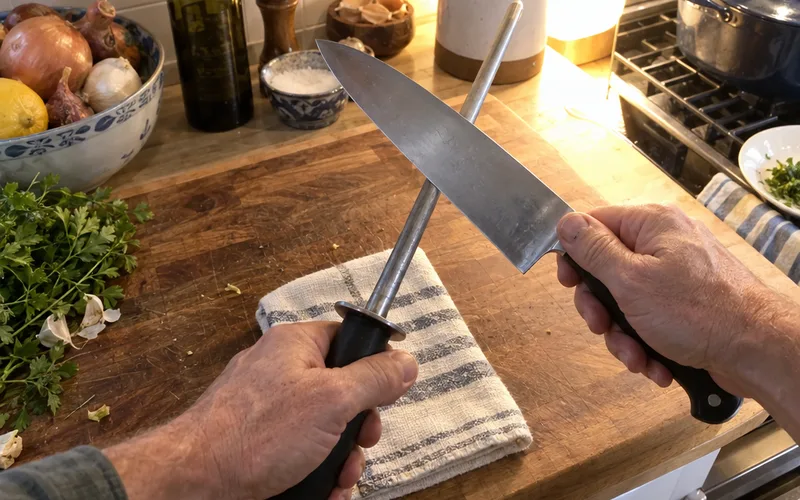
Think of the edge as a very thin strip of metal. With use, it rolls over to one side, and a few strokes on a honing steel stand it back up.
How Often to Sharpen Kitchen Knives
How often to sharpen kitchen knives depends on how much you cook, so skip the calendar and use a simple test. Sharpen when the knife slides off a tomato skin instead of biting in, even after honing.
You have 3 ways to do it. Sharpening on a whetstone gives the most control, a good knife sharpener is faster, and a mail-in service does it for you.
For example, the Knife Aid mail-in service listed a one-time sharpening package at $59.00 in November 2026. Subscribers paid $13.27 per knife, with free shipping.
Pro Tip: If you cook most nights, it pays to sharpen a knife at home and save the mail-in service for a badly chipped blade.
Washing and Storing Kitchen Knives
Kitchen knives last longest when you wash them by hand and keep the blades from touching other metal. A knife block, a magnetic strip or an in-drawer tray all do that job.
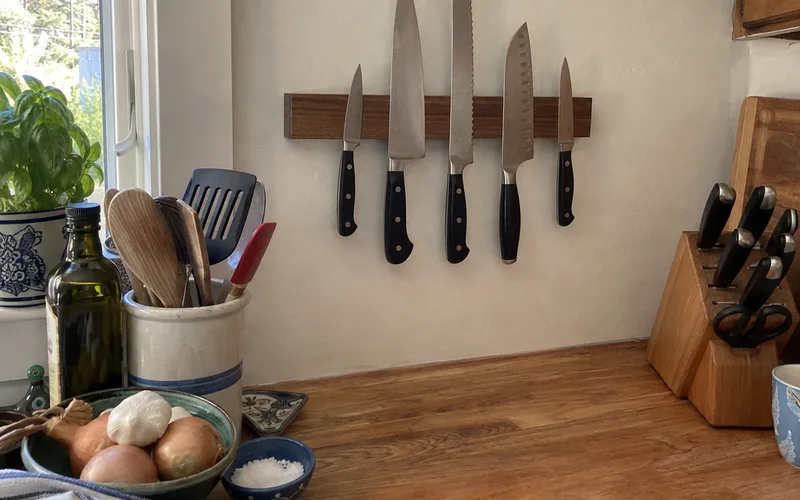
Both habits protect the edge, which is the part you paid for.
Can Kitchen Knives Go in the Dishwasher?
Kitchen knives shouldn’t go in the dishwasher, even ones labeled dishwasher safe. The heat, the detergent and the rattling against other utensils dull the edge and can crack wooden handles.
Instead, wash each knife with warm, soapy water and dry it straight away.
Never leave a knife hidden in a sink of soapy water, either. You can’t see the blade under the bubbles, which breaks one of the basic rules of kitchen knife safety.
The Best Way to Store Kitchen Knives
The best way to store kitchen knives is anywhere the blades stay apart and dry, such as a magnetic strip, an in-drawer tray or a knife block. A loose drawer is the worst spot, because blades bang into each other and into your fingers.
A wooden block works, but its slots are hard to clean and stay damp longer. It’s worth knowing how clean knife blocks really are before you push a damp blade into one.
A magnetic strip keeps blades dry and in sight. Mount it out of reach of small children, and set each knife on it spine first so the edge doesn’t scrape the metal.
Where to Start This Week
Buy a good 8-inch chef’s knife before anything else.
Then add a paring knife and a bread knife as your budget allows, and hone all 3 every few times you cook.
Those 3 knives cover most of what happens on your cutting board, alongside the rest of your cookware and cooking appliances.
Frequently Asked Questions
Is Zwilling or Wusthof better?
Neither Zwilling nor Wüsthof is clearly better, since both are German brands that make forged chef’s knives in the heavy, curved Western style. Hold one of each before you buy, because the handle that fits your hand matters more than the logo on the blade.
What brand of kitchen knives are the best?
The best kitchen knife brand depends on the style you want: German brands such as Wüsthof and Zwilling make heavier, tougher knives, while Japanese brands such as Shun and Miyabi make thinner, harder ones. Pick the style first, then the brand whose handle feels right.
How much does a nice set of knives cost?
A nice knife set costs about what its core knives cost on their own, and the Wüsthof listing priced a Classic 8-inch chef’s knife at $170.00 and a Classic 3 1/2-inch paring knife at $95.00 in November 2026. Price the 3 core knives first, then judge whether a set’s extras are worth the difference.
What are the best types of kitchen knives?
The best types of kitchen knives for a home cook are a chef’s knife, a paring knife and a serrated bread knife, which together handle most prep. A santoku can stand in for the chef’s knife if you prefer a lighter, straighter blade.
Where can I buy really good kitchen knives?
You can buy really good kitchen knives from knife makers’ own websites, specialty cutlery shops and big retailers, and Wüsthof, Cutlery and More and Target all sell them online. Hold a few in a store first if you can, because the handle has to fit your grip.